


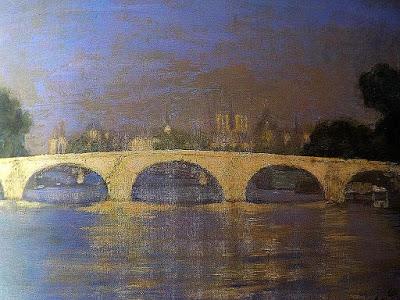
Le pont royal - Antonio de la Gandara
È verso la fine dell’Ottocento che nella Ville Lumière ha inizio la Belle Époque, un periodo destinato a entrare nella storia dell’umanità, pieno di vibranti aspettative carico di una certa fiducia nel futuro, ma di certo caratterizzato dalla nostalgia per il passato. In questo contesto socio-culturale spicca la figura di un grande pittore come Antonio de la Gándara.Di origine spagnola, nato a Parigi il 16 dicembre del 1861, impara l’arte della pittura da Jean-Léon .Gèrome e viene ammesso a soli quindici anni all’École Nationale Supérieure des beaux–arts de Paris, distinguendosi sin dagli esordi per il tratto pittorico ricercato, raffinato e nel contempo passionale, pulsante di tutte quelle speranze che caratterizzavano il periodo in cui si inseriva e dal quale era culturalmente influenzato.

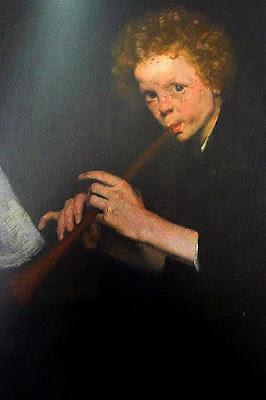
Jouer de flute - Antonio de la Gandara
Fuggi più che puoi il Frizzo Assassino,il crudele Motteggio e il Riso impuroche fanno lacrimare l’occhio dell’Azzurro,e tutto quest’aglio di bassa cucina!Prendi l’eloquenza e torcile il collo!Bene farai, se con ogni energiaFarai la rima un poco più assennata.A non controllarla, fin dove potrà andare?chi dirà i difetti della Rima?che bambino stonato, o negro folleci ha fuso questo gioiello da un soldoche suona vuoto e falso sotto la lima?L’artista pare acconsentire a questi insegnamenti innovativi. I suoi tratti pittorici, da tenui, cambiano, si alternano, divengono pulsanti di sfumature cromatiche che ben scrutano al di sotto delle apparenze, oltre la banalità, sottolineando il carattere, la persona, in tutta la sua interezza o incertezza.Sublime potere dell’arte, l’analisi introspettiva dell’essere umano! L’incertezza della vita, la caducità umana nei dipinti di de la Gandara sono vita vissuta. Il suo pennello tratteggia in modo originale ed eclettico virtù e vizi, potenza e limiti dell’essere umano. Il galantuomo ch’è in lui traspare da ogni tela dipinta. Sono periodi in cui l’arte tocca vette inaspettate in tutti i campi. Gustave Courbet, Latour, Bacchi, Renoir sono solo alcune figure del firmamento artistico cittadino. L’unicità dell’arte di Antonio de la Gándara traspare in modo netto ed evidente anche nei paesaggi parigini, che paiono essere opera di un impressionista. Le rive della Senna hanno visto sorgere un nuovo stile pittorico!Espone in quasi tutta Europa, dalla Germania al Regno Unito, dalla Russia alla Spagna, nonché in Italia, a Venezia e a Roma. Il suo stile è da subito apprezzato, il modo di dipingere, apprezzato.E musica, ancora, e per sempre!sia in tuo verso qualcosa che svola,si senta che fugge da un’anima in viaggioverso altri cieli e verso altri amori.Sia il tuo verso la buona avventuraspanta al vento frizzante del mattinoche fa fiorire la menta e il timo…Il resto è soltanto letteratura.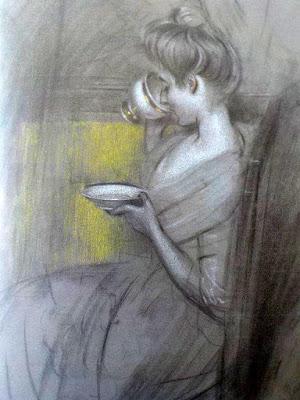
La tasse de the - Antonio de la Gandara
L’arte di Antonio de la Gandara non è manieristica. È innovativa e rivoluzionaria. Il sentimento pervade ogni sua opera, trabocca da ogni tratto. I ritratti – il suo genere prediletto – sono in realtà vere e proprie introspezioni psicoanalitiche che tendono a far risaltare l’uomo in tutta la sua complessità. Sarà però Charlotte, che sposerà nel 1909, la sua vera musa ispiratrice nell’arte della “divina mania”.Antonio de la Gándara stupirà il mondo, compresi gli Stati Uniti d’America dove esporrà a New York e Boston. La critica di quell’epoca sottolinea le qualità di questo pittore che rimane avulso dalle correnti pittoriche del suo tempo. In realtà, non è possibile non scorgere tracce di quell’Impressionismo che imperversava per le strade di Parigi , lungo la Senna… nei bistrot degli intellettuali e negli studi d’arte! Apollinaire di lui scrisse:"Il est fier comme un hidalgoJ’aime mieux son port de tèteQue sa peinture Bien qu’lle soit honorableIl achète un journal au kiosque et paieD’un gesteDistinguèJe dètache le mot distinguè comme son geste est détaché, tu vois.Il n’ira pas chez LippEn faceMalgrè la bonne bièreEt rentre chez luiD’un pas choisi (…)”Dopo aver strabiliato il mondo intero con la sua arte a ogni esposizione, a ogni personale, ritornerà nella sua tanto cara e amata Parigi dove si spegnerà il 30 giugno del 1917, lasciando a tutti noi opere che gli valsero, con merito, il paragone con Velázquez! Semplicemente un grande interprete della pittura mondiale.Fabio Viganò.
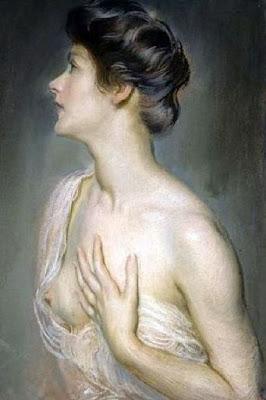
Le femme au voile - Antonio de la Gandara
Traduzione di Andrea Carlo Cappi.
Antonio de la Gandara, genius and refinement
At the end of the 19th century, in the Ville Lumière, the Belle Époque begins: a period which will mark the history of mankind, full of vibrating expectations, charged with some faith in the future, but for sure marked by loving memories of the past. In this socio-cultural context, the great painter Antonio de la Gándara stands out.Of Spanish origin, born in Paris on december 16th, 1861, he learns the art of painting from Jean-Léon Gèrome and is admitted, just fifteen years old, at the École Nationale Supérieure des beaux–arts de Paris; since the beginning he iss noticed thanks to his distinguished, refined and at the same time passionate touch, vibrating with all the hopes of the age and the cultural influence he lived in.Important names of literature, not only from Paris, are among his friends: Proust, Verlaine – writer the first, poet the latter – are just some of the people he used to meet. Verlaine and all the other maudits, from Baudelaire to Rimbaud, will undoubtedly lead him to symbolism and soomehow toward Impressionism. He will thouroughly embrace, fascinated, Verlaine’s poetic manifesto of 1882:Music above allHence choose the uneven verse,vaguer and softer;nothing in it is majestic and heavy.You also need to choosewords with some imprecision:nothing more beloved of ambiguos singingwere precision meets uncertainty.Beautiful are the eyes behind veilsthe immense day vibrating at noonand for a lukewarm autumn skythe opaque blue of the bright stars!Stars of the art shine from Paris to Milan in a troubled sky. In Milan the Scapigliatura is expressing itself in all forms of art: sculpture, painting, poetry and music. In Belfast the Titanic is built, the unsinkable British ship. The whole world is burning with ideas and innovation.Meanwhile, in Paris, Antonio de la Gándara reads and reads again his friend Verlaine’s poetic manifesto. He discusses it with the prince of Polignac, Lyane de Pougy, Ida Rubinstein, as well as with the count of Montesquieu. The course is set!Avoid at all costs the Killing Brilliancethe cruel Wording and the impure Laughthat draw tears fron the eye of Blue,and all the garlic from the low kitchen!Take eloquence and strangle it!Good you will do if with all energyyou make your rhyme a little sounder.Where will it go, if you do not control it?Who is going to tell the Rhyme’s faults? Which child out of key or crazy negromade this unworthy jewelwhich sounds empty and fake under the file?The artis seems to agree with all these teachings of innovation. His painting, soft at the start, changes, vary, start pulsating with colour shades, exploring beyond appearances, beyond banality, underlining attitudes, persolanities in the whole, including their uncertainties.Wonderful power of the art, the introspection of the human being! The uncertainty of life, the frailty of man become real life in de la Gándara’s paintings. His brush portrays, in an original and eclectic way, vice and virtue, power and limits of the human being. The gentleman in him appears in every work of his.In this age, art reaches unexpected heights in every field.Gustave Courbet, Latour, Bacchi, Renoir are just a few names in the artistic scene of the city. The uniqueness of Antonio de la Gándara’s art appears clearly in his Paris landscapes, which look like the work of an impressionist. The Rives of the Seine have just seen the birth of a new style!His work is shown in exhibitions all across Europe, from Germany to United Kingdom, from Russia to Spain, even in Italy, in Venice and Rome. His style is immediately appreciated.And music, again and forever!Let it be seen flying in your verselet it be heard running from a traveling soultowards other skies, towards other loves.Let your verse be good adventure,blown in the cold wind of the morningwhich makes mint and thyme bloom.The rest is nothing but literature.Antonio de la Gándara’s art is not manieristic. It’s new, revolutionary. This feeling fills every work of his, pouring out of every trait. Portraits, his favourite subject, are actually psichoanalitic views of men and women in all their complexity. But Charlotte, whom he’ll marry in 1909, will be his real muse in the art of the “divine mania”.Antonio de la Gándara will astonish the world, including the United States of America, with his exhibitions in New York and Boston. Critics of the time underline the qualities of this artist, which remains isolated from the currents of painting of his age. Though you can see traces of the Impressionism that was storming the street of Paris, along the Seine, the intellectual’s bistrots and the art studios! Apollinaire wrote about him:Il est fier comme un hidalgoJ’aime mieux son port de tèteQue sa peinture Bien qu’lle soit honorableIl achète un journal au kiosque et paieD’un gesteDistinguèJe dètache le mot distinguè comme son geste est détaché, tu vois.Il n’ira pas chez LippEn faceMalgrè la bonne bièreEt rentre chez luiD’un pas choisi (…)”After surprising the world with his art, at each exhibition, he returns to his beloved Paris, where he dies on june 30th, 1917, leaving us works that had him – with reason – compared to Velázquez! Simply a major figure of world painting.
Fabio Viganò ed Andrea Carlo Cappi.







 Pacman
 Nostradamus
 Magical Cat Adventure
 Snake
Snake